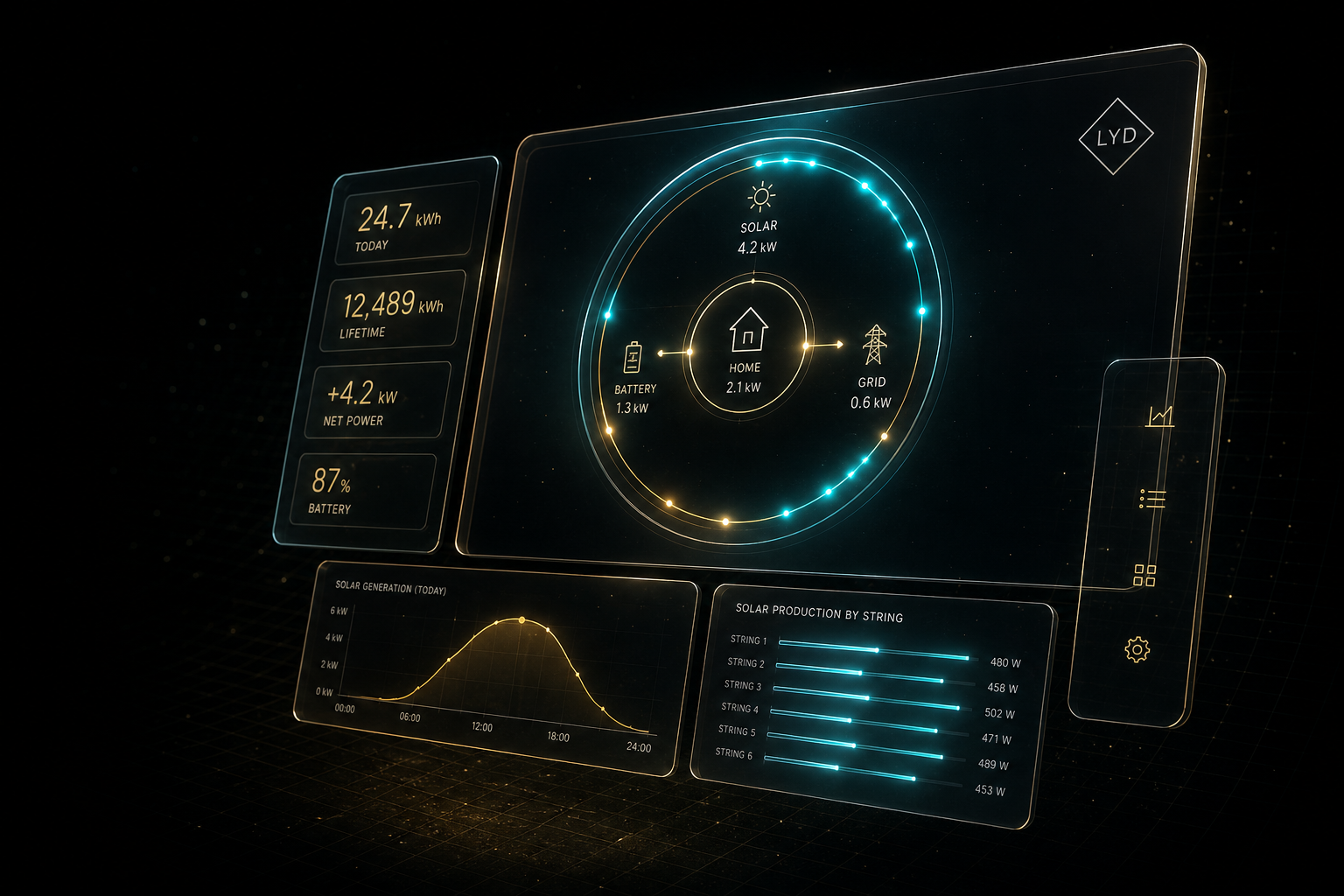
Holographic Lucid OS dashboard floating in a futuristic dark space, with glowing cyan rings, gold accents, and data visualisations across multiple translucent UI panels

The platform behind every LYD product

Lucid OS

One intelligence. Every product. The energy operating system that runs on every Orbit, every SafeCell, every Photon string, and every LYD vehicle — and renders all of them as one coordinated household, factory, or grid in the palm of your hand.

7

Product surfaces

1

Mind

< 50 ms

Local decisions

100 MW+

Scale ceiling

What Lucid OS is

Three jobs. One mind.

Lucid OS isn’t a monitoring app. It is the operating system that coordinates every LYD product into one household, every household into one fleet, every fleet into one grid. It does three things, and it does them on every surface where it lives.

Pillar 01

Coordinate

Every product, one system.

Lucid OS speaks to every Orbit, every SafeCell, every Photon string, and every LYD vehicle in your installation as a single coordinated system. No app-per-device, no app-per-brand. One memory model. One dashboard. One mind.

  • Single source of truth across all hardware
  • Same interface from one home to a hundred sites
  • Hardware-agnostic memory model
Pillar 02

Predict

Forecast, then prevent.

Lucid OS doesn’t just report what just happened — it forecasts what is about to. Weather-aware solar yield, load-curve learning, tariff-window optimisation, and anomaly detection that flags a lagging panel weeks before its monthly bill does.

  • 7-day weather-aware generation forecast
  • Load-curve learning per appliance window
  • Anomaly detection before yield drops
Pillar 03

Adapt

Learn your house, your day, your year.

Every household uses energy differently. Lucid OS watches — with consent — how your home actually behaves and shifts charging windows, discharge priorities, and tariff exposure to match. The longer it runs, the better it gets.

  • Per-household load-shape modelling
  • Tariff-aware automation rules
  • Quiet mode, geofence mode, away mode

Across every product

Seven surfaces. One operating system.

From a 4-inch OLED ring on your wall to a multi-monitor SCADA console in a substation, Lucid OS wears different clothes for different audiences — but the data model, the design language, and the brain underneath are one and the same. Here’s what it looks like wherever you find it.

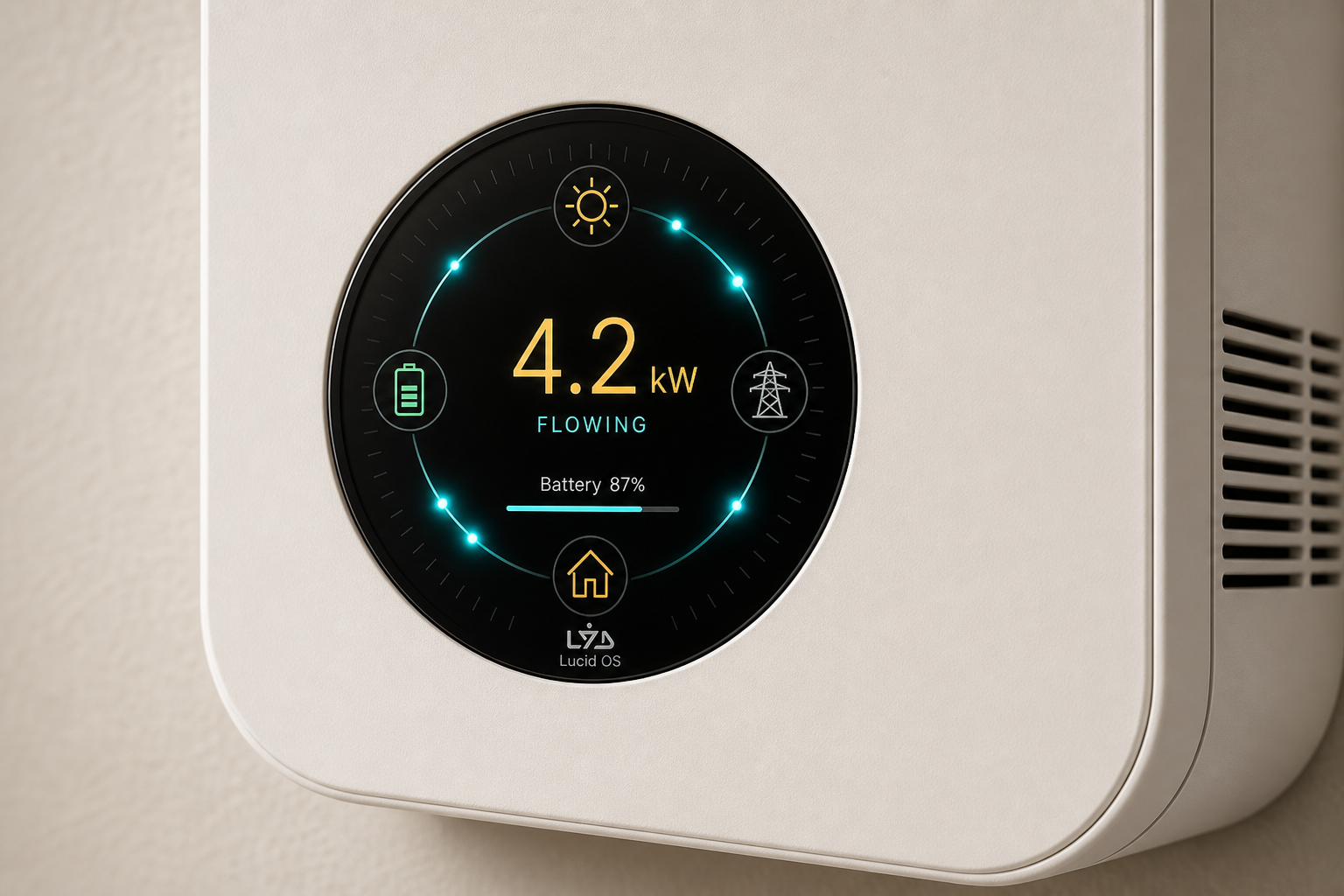
Close-up of LYD Orbit’s circular OLED display showing Lucid OS with animated solar, battery, grid, and home power-flow ring in cyan glow
Circular OLED display

01 / On the wall

Orbit

The energy core · for the homeowner

A circle of intelligence.

Every Orbit carries a 4-inch circular OLED that orbits around its own animated power-flow ring. Sun on the left, battery at the bottom, grid on the right, home in the middle — and the cyan dots that travel between them are not animation, they are the live current. Touch anywhere to drill in.

  • Live solar / battery / grid / load ring
  • Glanceable status from across the room
  • Tap-through to mode, schedule, diagnostics
  • Same UI on every Orbit One through Nine
Explore Orbit
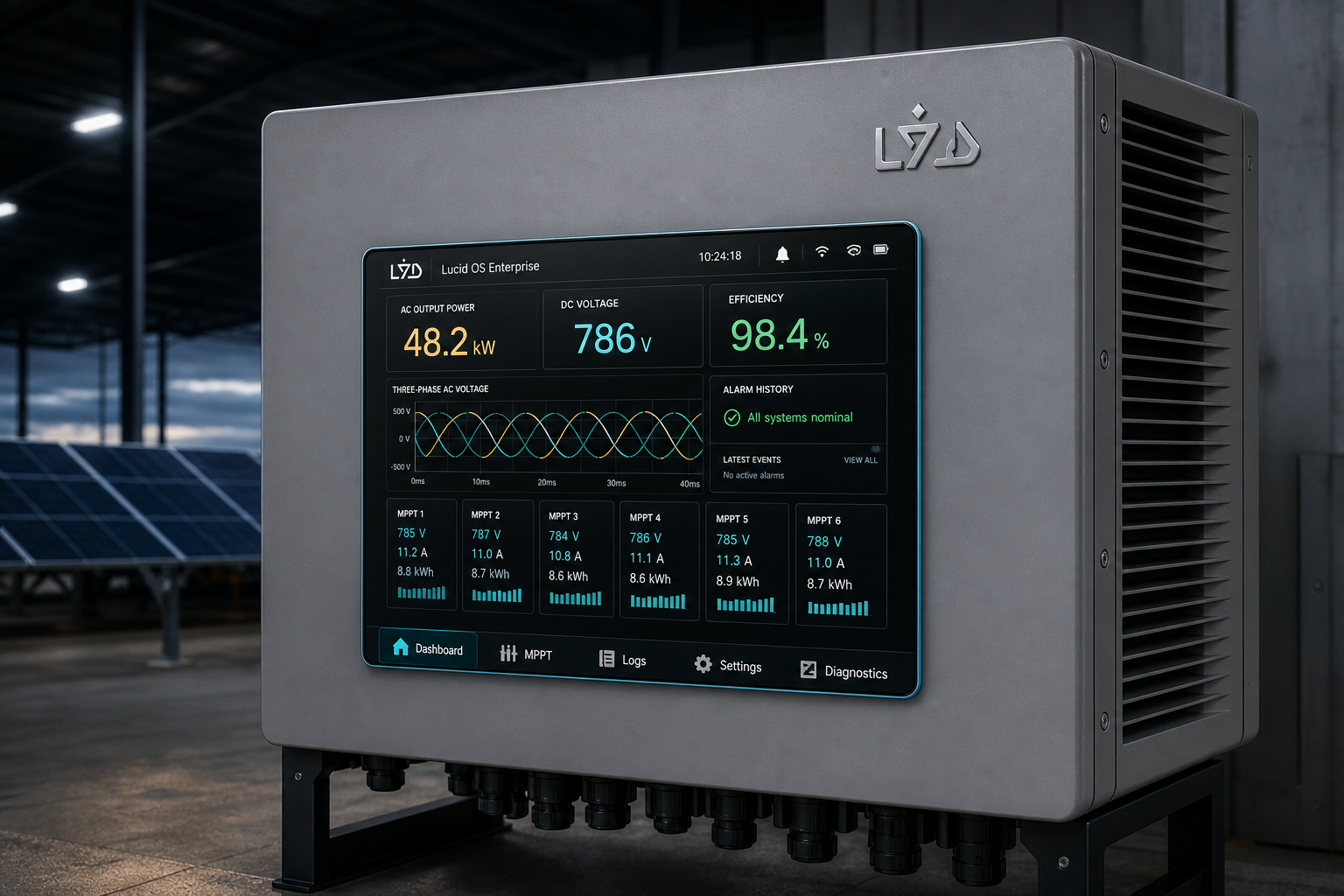
LYD Orbit X 7-inch colour touchscreen HMI showing Lucid OS Enterprise with three-phase power, MPPT inputs, and alarm history
7-inch colour touchscreen HMI

02 / On the plant floor

Orbit X

Commercial inverter · for the facility manager / electrician

Operator-grade, designer-built.

Orbit X carries a 7-inch colour touchscreen that runs the same Lucid OS, scaled up for commercial operators. Three-phase voltage and current on a single dashboard, MPPT-by-MPPT input cards, alarm history, audit logs. Built so a maintenance electrician can read a fault at arm’s length without a manual.

  • Live three-phase voltage, current, frequency, kVAR
  • MPPT cards — per-input voltage, current, yield
  • Alarm history & audit logs on the device
  • Drives parallel-stack coordination automatically
Explore Orbit X
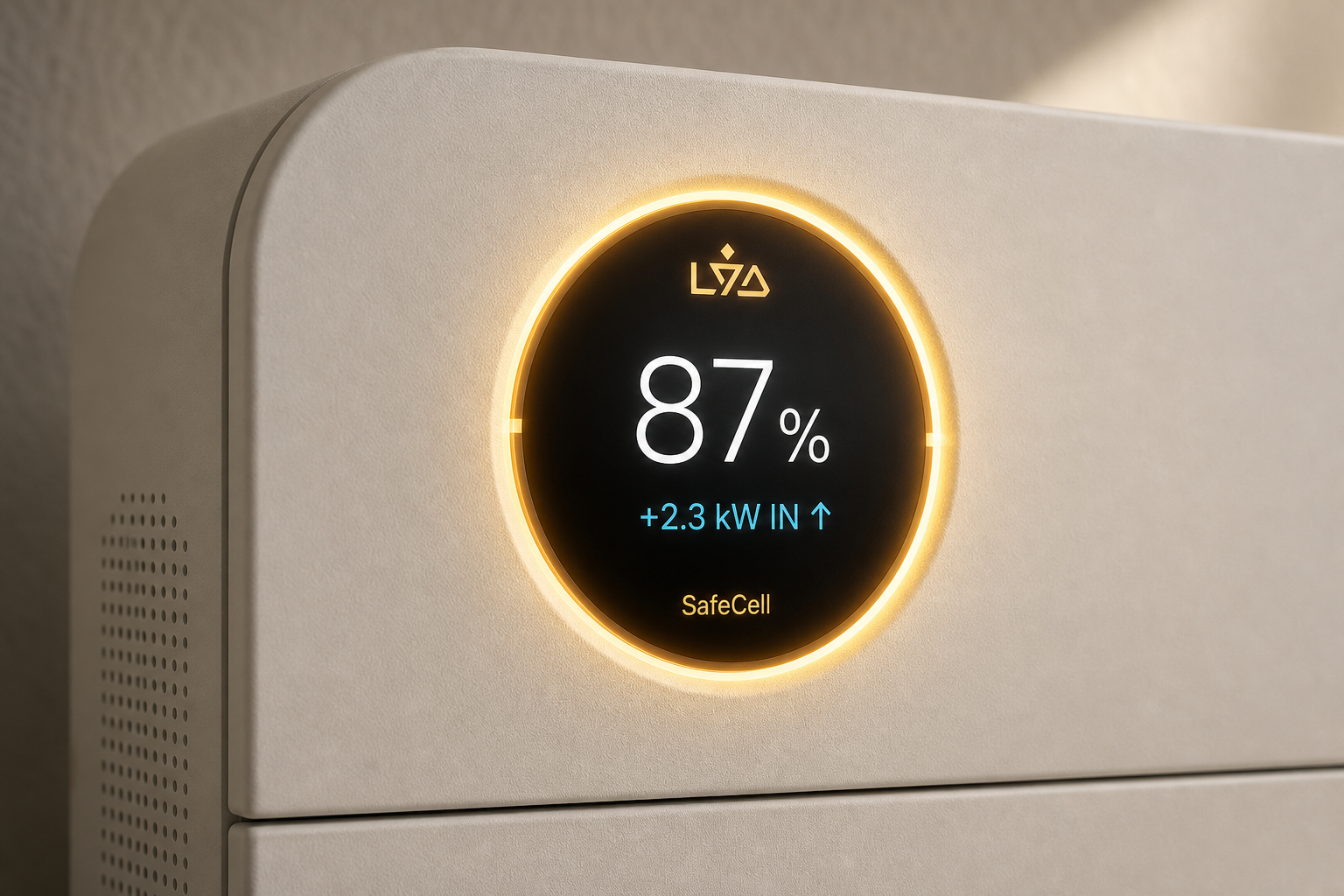
Close-up of LYD SafeCell’s status-ring OLED glowing gold, showing state of charge and live current flow
Status-ring OLED

03 / On the battery

SafeCell

Residential energy storage · for the homeowner

A halo that tells you the story.

Each SafeCell wears a status-ring OLED that pulses with the cell’s charge state. Solid gold when full; a slow exhale when discharging; a steady inhale when soaking up solar. State-of-charge to the nearest percent in the centre, instantaneous in / out flow on the rim. The whole wall reads like one organism.

  • Pulse-rate encodes charge/discharge speed
  • State-of-charge centre digit at a glance
  • Per-module health status on the modular SKUs
  • Same ring across 5 kWh wall mount to 32 kWh floor
Explore SafeCell
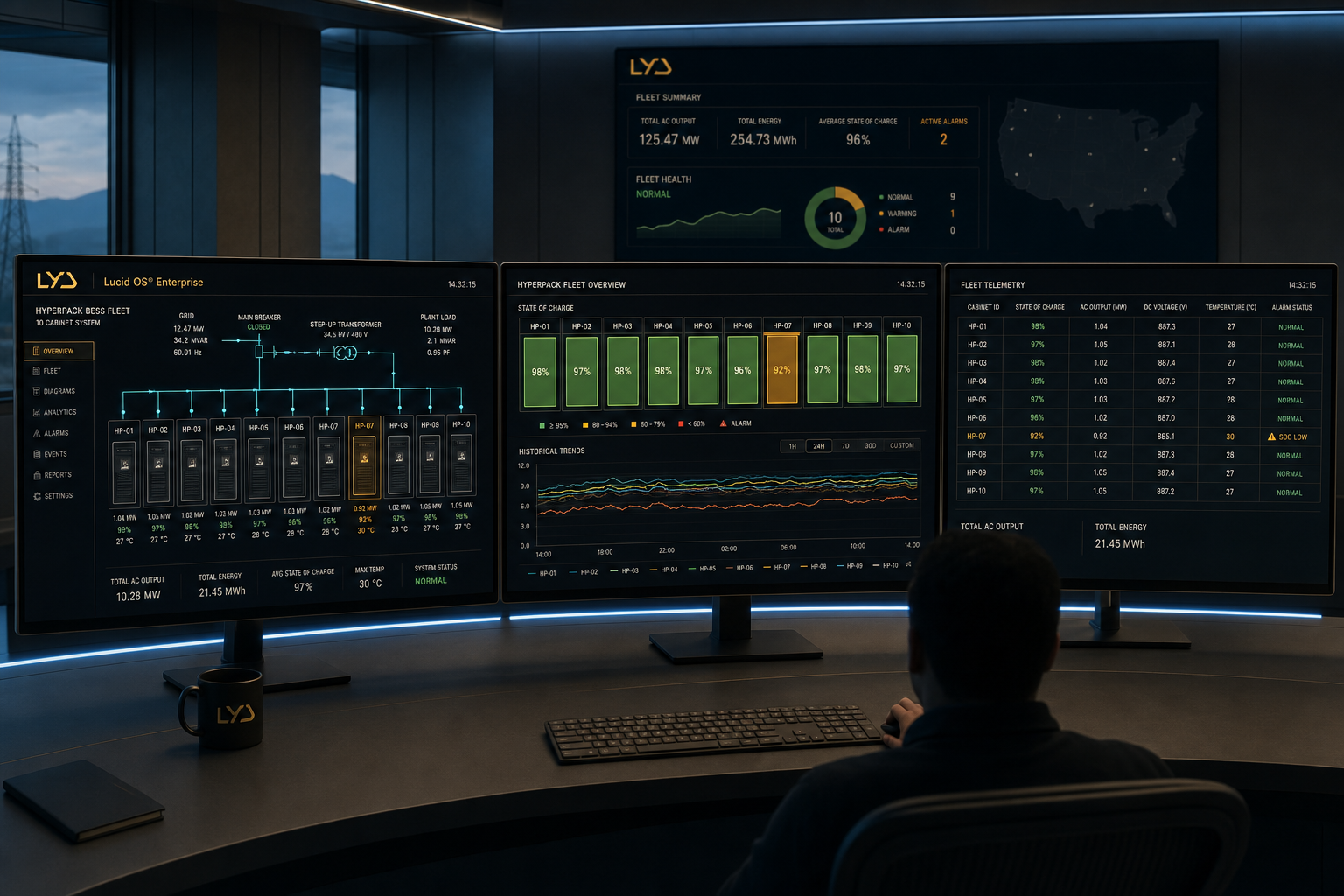
Plant operator at a multi-monitor SCADA console running Lucid OS Enterprise, with live SafeCell Hyperpack fleet diagrams and a state-of-charge heatmap
Operator SCADA console

04 / In the control room

SafeCell Hyperpack

Utility-scale BESS · for the plant operator / epc

Megawatts, on a single pane.

Lucid OS Enterprise reads the same memory model the residential SafeCell does, just exposed through the protocols a utility operator needs: Modbus TCP, DNP3, IEC 61850, OPC UA. One screen, one fleet, line diagrams that animate live and a state-of-charge heatmap that lets an operator find the lagging cabinet across a 10 MW field in a glance.

  • Single-pane multi-cabinet fleet view
  • Line diagrams that animate with live current
  • Cabinet-level state-of-charge heatmap
  • Modbus / DNP3 / IEC 61850 / OPC UA out of the box
Explore SafeCell Hyperpack
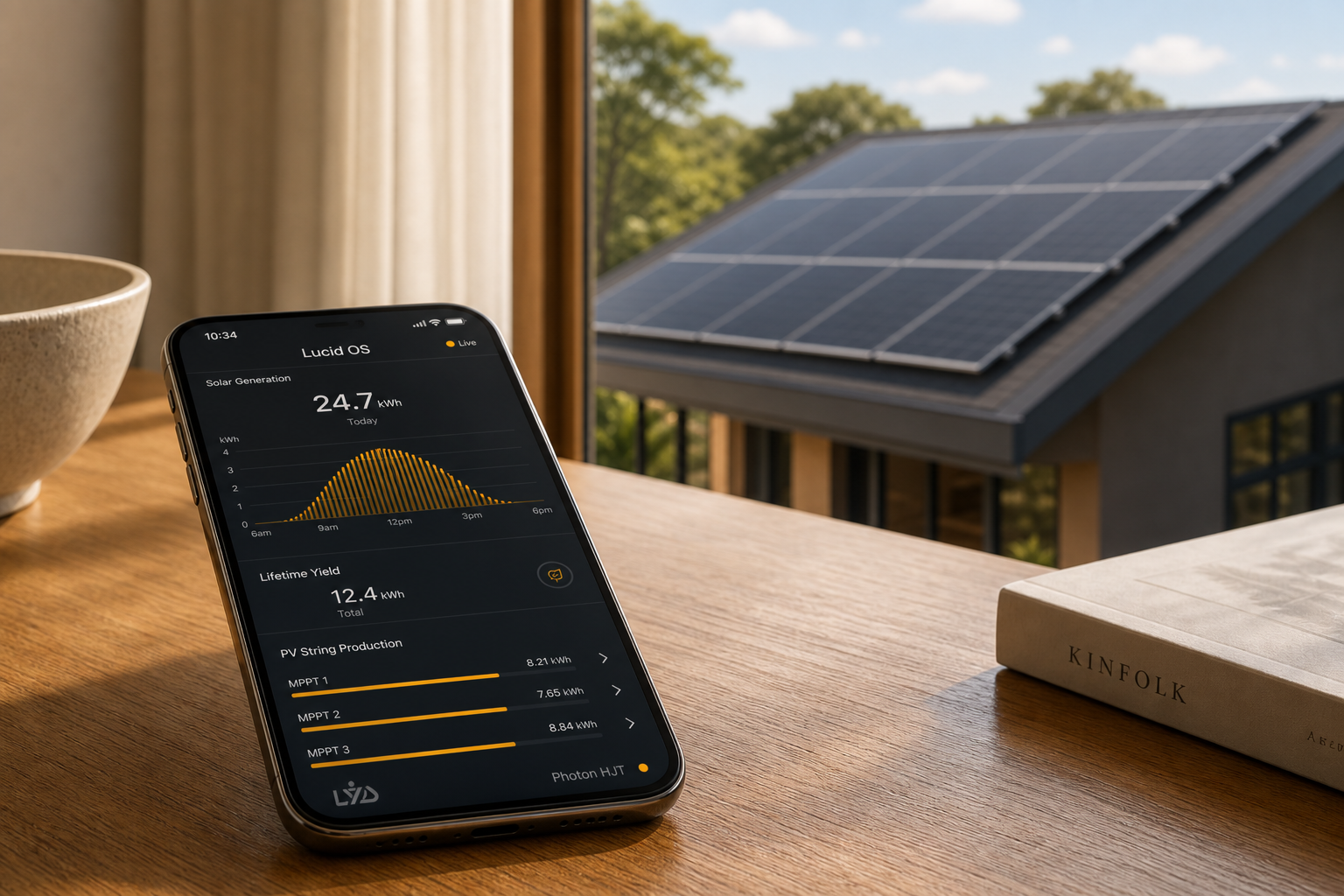
Lucid OS dashboard showing Photon solar array string-level telemetry, with a coloured heatmap of panels and daily yield curve
String telemetry surfaced through Orbit

05 / On the roof

Photon

HJT solar panels · for the homeowner / installer

Every panel, telemetered.

Photon doesn’t carry a screen of its own — it broadcasts. Per-string current and voltage flow up to the Orbit it’s wired to, and Lucid OS turns the array into a coloured heatmap. The lagging panel from last Tuesday’s harmattan storm is the one shaded amber on Wednesday morning, before anyone’s climbed onto the roof.

  • Per-MPPT-string voltage / current / yield
  • Array heatmap with anomaly flagging
  • Daily / monthly / lifetime yield charts
  • Predictive alerts before the bill notices
Explore Photon
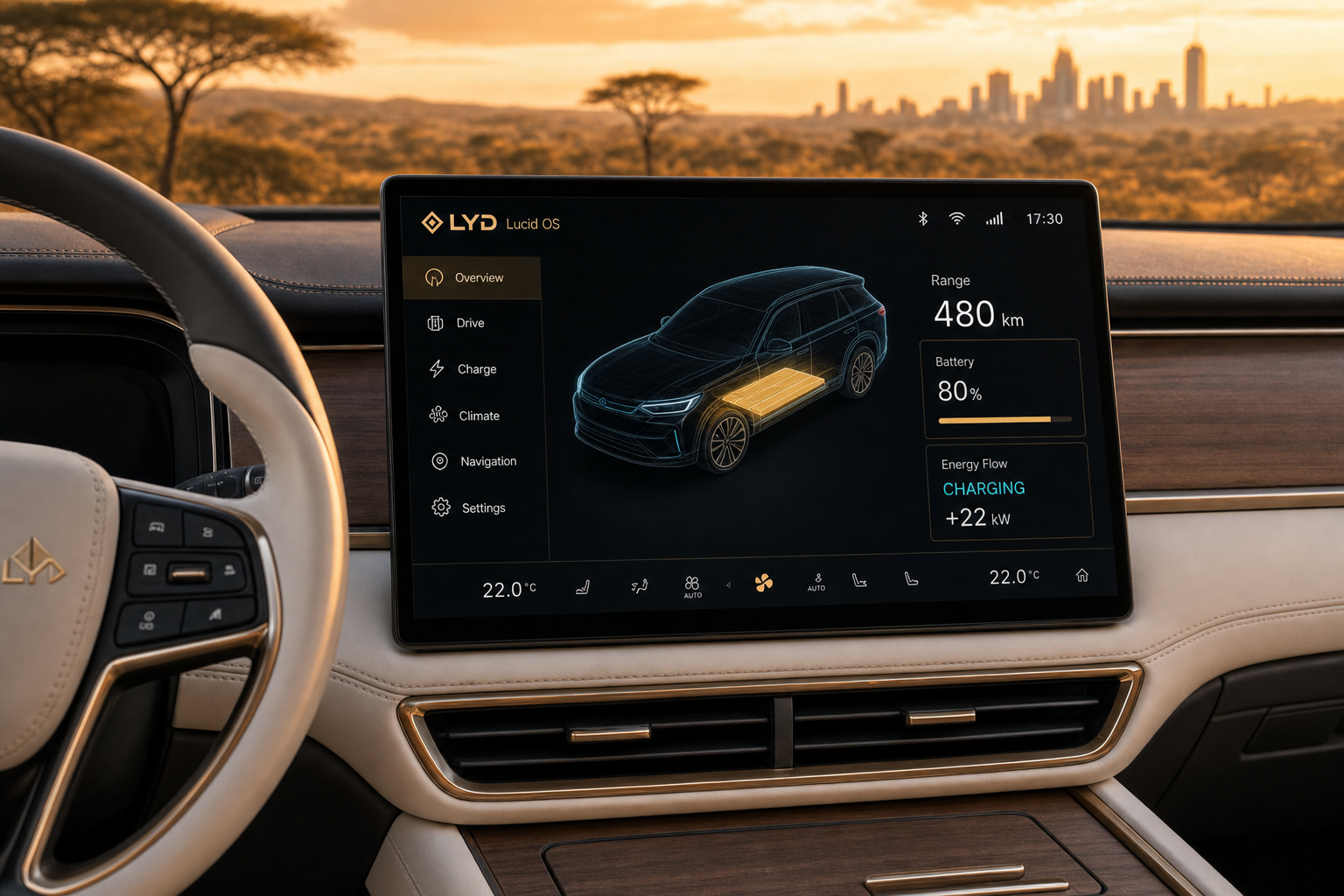
View from inside an LYD Phantom X showing the central Lucid OS touchscreen with range, state of charge, and energy consumption curve
In-vehicle central display

06 / On the road

Phantom X / Nova / Flux 3

LYD mobility · for the driver

The same OS, eighty kilometres an hour.

The LYD vehicles run Lucid OS on the central display. Range and state-of-charge are graphed the same way they are on Orbit at home, which means once you’ve learned one interface you’ve learned all of them. Park the car under your carport and the battery becomes part of the household ring — V2H-ready when the regulators are.

  • Range, SOC, climate, navigation in one canvas
  • Energy curve identical to the Orbit dashboard
  • V2H-ready — the car can back up the house
  • Schedule charging against your tariff window
Explore Phantom X / Nova / Flux 3
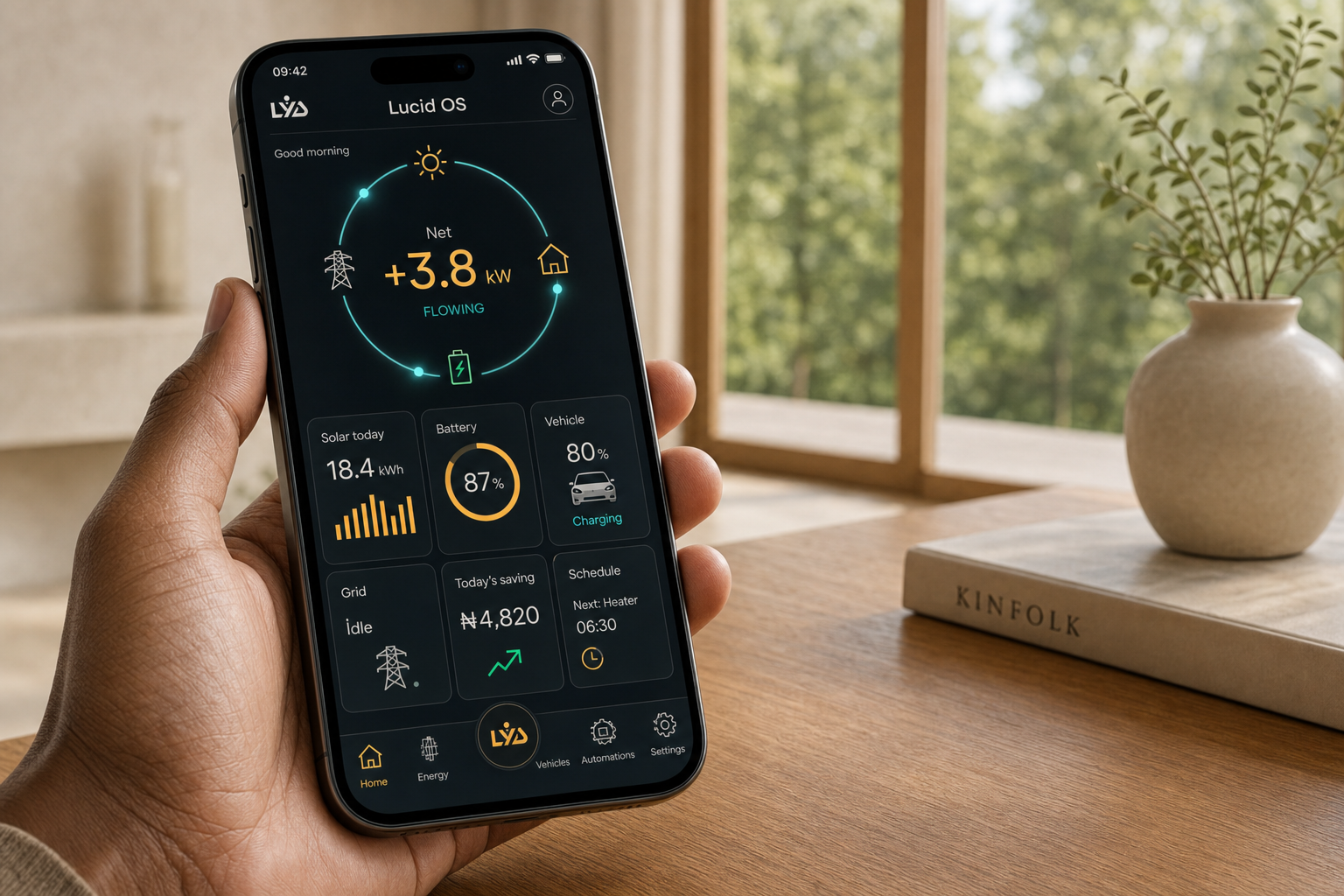
LYD Lucid OS companion app on a smartphone showing a unified household view — solar, battery, grid, vehicle, and automation tiles
iOS / Android app and browser console

07 / In your pocket

Companion

Mobile + web · for the everyone

The whole household, in your hand.

The companion app is where every Lucid OS surface meets. Solar generation, battery state, grid status, the car parked under your carport, the schedule that fires the geyser an hour before you wake up — all on one screen. The web console exposes the same data to installers, distributors, and fleet operators, with the multi-site view their work needs.

  • Unified household view across every LYD product
  • Remote start, stop, mode switch, schedule edit
  • Tariff-aware automation rules you can read
  • Web console with multi-site, multi-tenant access
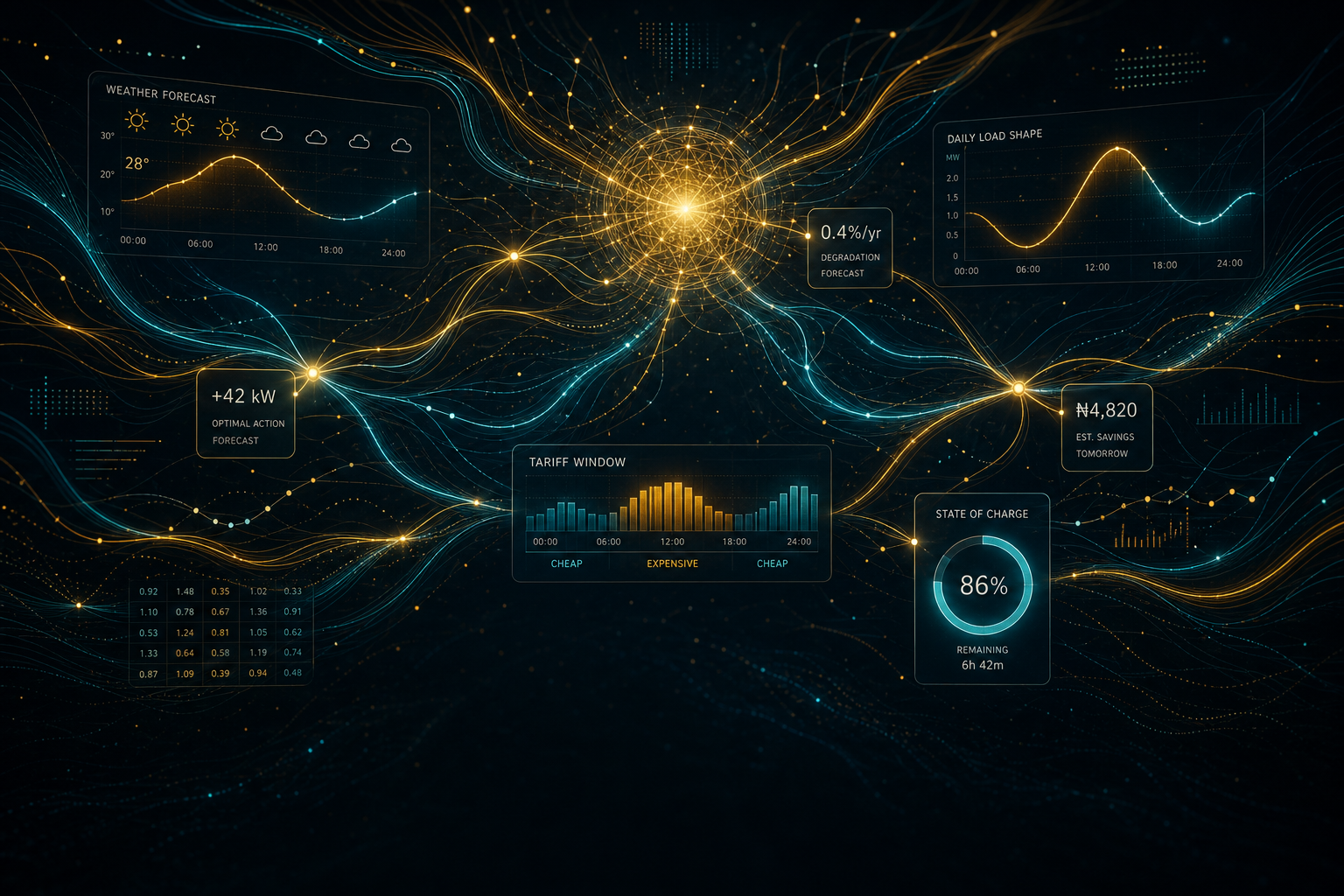
Abstract visualisation of Lucid OS\u2019 AI layer \u2014 glowing neural-style data flows with weather curves, load shapes, and tariff windows woven through a dark futuristic canvas

The brain you never see — until it’s right.

The intelligence layer

Software that forecasts, not just reports.

Every Lucid OS surface is fed by the same predictive kernel. Weather, tariff windows, your home’s actual load shape, the seasonal curve each Photon string has settled into — all of it informs the decisions Orbit takes a few hundred times a second.

Weather-aware forecasting

Lucid OS ingests local weather forecasts and predicts the next 7 days of solar yield down to the hour. Your battery starts the morning at the right state of charge for the day you’re actually going to have.

Load-curve learning

Within a fortnight, Lucid OS has learned the rhythm of your home: when the kettle fires, when the AC ramps up, when the lights go off. Schedules then anticipate, not react.

Tariff-aware automation

Tell Lucid OS your utility tariff windows once. It charges when power is cheap, discharges when power is expensive, and — where regulations permit — sells back when it pays to.

Anomaly detection

Lucid OS knows the expected curve for every Photon string, every Orbit MPPT, every SafeCell module. The lagging cell that’s about to fail is flagged on a graph long before it shows up on a bill.

Load prioritisation

When reserves get low, Lucid OS knows the fridge keeps running and the dryer waits. Per-circuit prioritisation, configured once, applied automatically every time the grid drops.

Fleet automation

For installers and distributors: rules-based automation across hundreds of customer sites. Push a firmware update, mute an alarm class, or rebalance a fleet of Hyperpacks from a single console.

Architecture

Built like the grid it depends on.

Energy infrastructure can’t go down when the internet does. Lucid OS is engineered the way utilities engineer their own SCADA: distributed, encrypted, redundant, and resilient to its hosts dropping in and out without anyone noticing.

Edge-first compute

Every Orbit ships with a dedicated compute module. Lucid OS runs locally on the device — the cloud is for sync, history, and remote access, not for decisions. Lose the internet, keep the lights on.

Mesh-aware networking

Orbit, SafeCell, Photon, and the vehicles speak a private LYD mesh over CAN, RS-485, and Wi-Fi 6. No single point of failure; the system reorganises around dropped links automatically.

Encrypted, end-to-end

Device-to-device traffic is end-to-end encrypted with hardware-rooted keys. Device-to-cloud uses TLS 1.3 with certificate pinning. Your power data leaves your house only with your permission.

Local-mode resilient

Cloud down? Network down? Lucid OS keeps running. Schedules, automation rules, and SCADA endpoints all execute locally; the device catches the cloud up when the link returns.

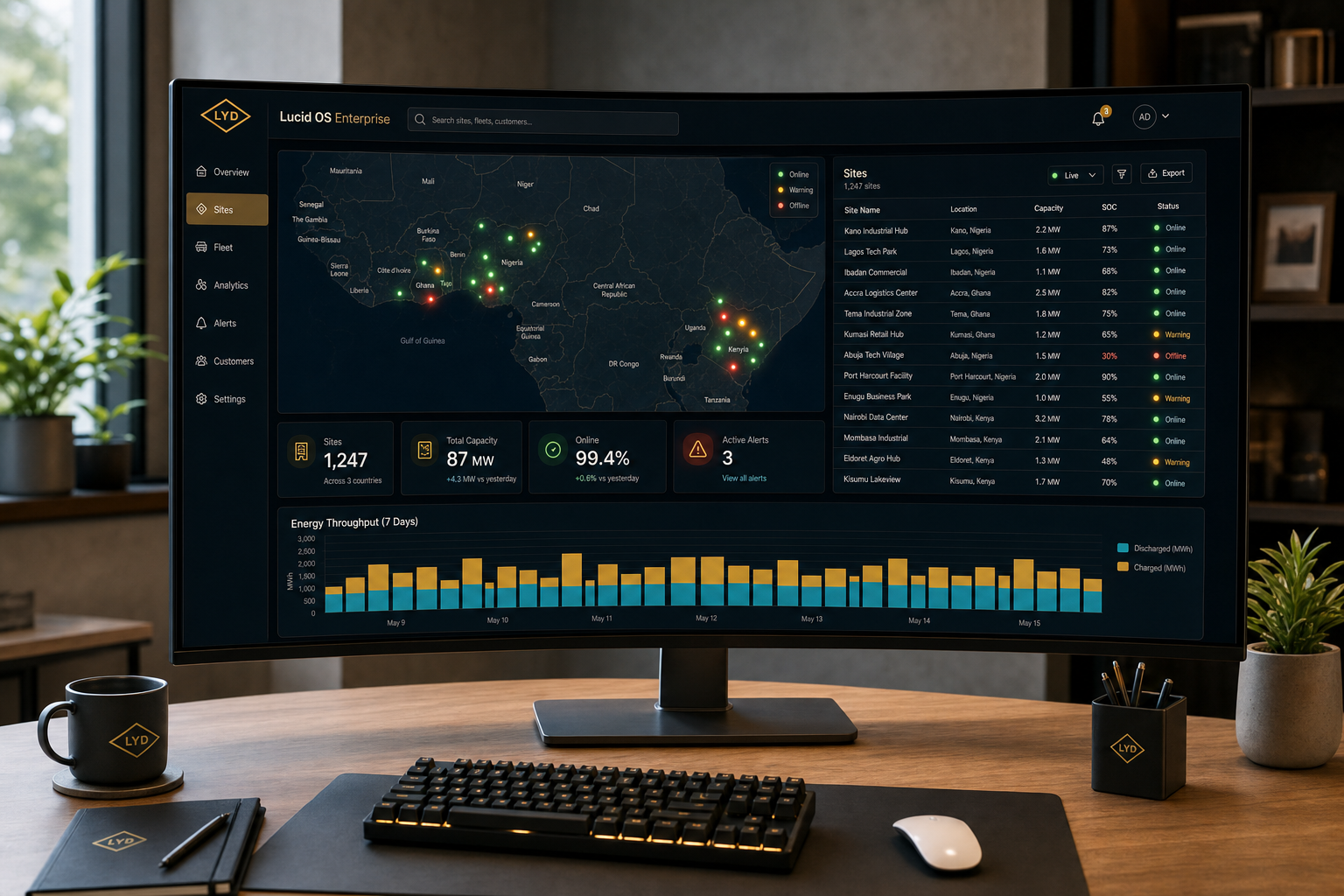
LYD Lucid OS web console showing multi-site fleet view, real-time energy maps, and historical analytics on a modern dark dashboard

From one home to one grid

Same OS at every order of magnitude.

The decision Lucid OS makes for one home in Lekki is the same decision it makes for a 100 MW BESS field in another country — just multiplied by every cabinet, string, and meter on the bus. Scale isn’t a feature you add later. It’s the architecture.

Scale 01

One home

1 site

A single Orbit, one SafeCell, a string of Photon. The dashboard fits on one phone screen.

Scale 02

A street

10 – 100 sites

A neighbourhood’s worth of homes, coordinated through the same companion app. Installers see them as one fleet.

Scale 03

A commercial site

1 MW

A factory or hotel with parallel Orbit X stacks, multiple Hyperpacks, and a private microgrid. Same OS, same view.

Scale 04

A regional grid

100 MW+

A utility deploying hundreds of Hyperpacks across a transmission region. SCADA-grade visibility on every cabinet.

Be first in line

Join the waitlist for early access to LYD products, exclusive pricing, and updates on our journey to power the clean energy future.

No spam, ever. We’ll only send meaningful product updates.